
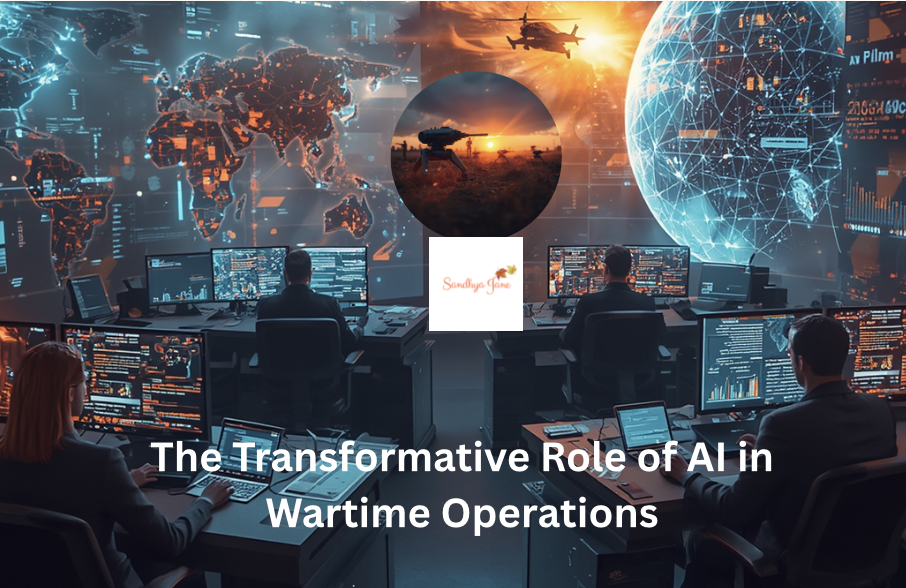
In the ever-evolving landscape of military operations, AI stands as a beacon of change, revolutionizing how wars are fought by rapidly processing vast data sets, enabling autonomous systems, optimizing resources, and aiding in critical decision-making—all while reducing the direct risks to personnel. For instance, during the Russia-Ukraine conflict, AI’s prowess was evident as it enhanced drone strike accuracy from 30-50% to about 80% through AI-driven targeting, significantly speeding up intelligence cycles and optimizing operational effectiveness.
Across various domains—military, medical, logistics, intelligence, and support roles—AI serves as a force multiplier. By managing repetitive tasks and data overload, offering predictive insights, and enabling operations in jammed or contested environments, AI transforms the battlefield dynamic. While human oversight remains indispensable for ethical considerations and final decisions, AI compresses timelines from days to mere minutes or even seconds, creating a paradigm shift in wartime operations.
- Intelligence Analysts and Commanders: Enhanced Situational Awareness and Targeting
AI seamlessly integrates data from drones, satellites, sensors, and social media to:
- Identify threats
- Anticipate enemy movements
- Generate targeting packages
For example is the U.S. Project Maven, which analyzes drone footage in real-time, alleviating the workload of analysts and facilitating strikes that previously took hours or days. In the Ukraine conflict, AI aids commanders in constructing a “digital model of the battlefield” to track forces and prioritize targets, even with limited sensors. Large language models can swiftly produce operational plans, weather matrices, and modified combined obstacle overlays (MCOOs).
Key benefit: Minimizes cognitive overload in chaotic situations and accelerates decision-making for mission command.
2. Drone Operators and Unmanned Systems Specialists: Autonomous Operations in Challenging Environments
AI-driven drones and swarms operate with minimal human intervention by utilizing computer vision to:
- Lock onto targets
- Navigate without GPS
- Evade jamming
In Ukraine, AI modules on FPV drones enable autonomous terminal guidance, transforming them into “killer drones.” Swarm intelligence allows groups of drones to autonomously coordinate strikes, mine-laying, or reconnaissance after initial human input, allowing operators to transition from manual control to higher-level management, reducing exposure to enemy fire.
Key benefit: Facilitates “last-mile” autonomy in zones with heavy electronic warfare, scaling operations with fewer personnel.
3. Logisticians and Supply Chain Managers: Predictive and Resilient Sustainment
Wartime supply lines are vulnerable to attacks, and AI is crucial in:
- Forecasting demand
- Predicting bottlenecks
- Optimizing routes during disruptions
- Managing inventory in real-time
For example, the U.S. Defense Logistics Agency employs AI to monitor supply chain risks, predict requirements, and suggest alternative suppliers. In Ukraine and other military contexts, AI aids in predictive maintenance for vehicles and supports on-demand 3D printing of parts, while autonomous ground vehicles and drone swarms manage deliveries in contested areas.
Key benefit: Prevents shortages, reduces waste, and ensures readiness even amid traditional logistics disruptions.
4. Medical Professionals (Medics, Doctors, and Triage Teams): Rapid Diagnostics and Remote Support
Battlefield medicine faces the challenge of mass casualties and austere conditions. AI plays a vital role in:
- Assisting with triage
- Analyzing images (e.g., X-rays/CT scans for injuries)
- Adjusting ventilator settings
- Providing conversational guidance for non-specialists
For example, tools like AI-GUIDE facilitate interventions, while models enhance decision-making accuracy in simulations by nearly 80% for tasks such as ventilator management. Conversational AI agents offer clear, step-by-step Tactical Combat Casualty Care instructions to soldiers with minimal training. AI also supports patient monitoring during medevac and mental health assessments for PTSD in veterans.
Key benefit: Extends limited medical resources, accelerates life-saving decisions, and provides care when specialists are unavailable.
5. Planners, Cyber Defenders, and Support Roles: Simulation, Cybersecurity, and Efficiency Planners: AI conducts wargames, simulates scenarios, and generates action plans more quickly than traditional approaches.
Cyber professionals:AI identifies and mitigates threats at machine speed in contested networks.
Engineers and maintenance staff:Predictive analytics forecast equipment failures and enhance repair processes.
A pertinent example is the integration of AI through systems like the U.S. Joint All-Domain Command and Control (JADC2), which facilitates seamless data sharing among forces.
Challenges to Consider
While AI offers significant advantages, potential challenges include:
- Over-reliance, which can lead to errors (e.g., misidentification)
- Adversarial attacks on AI systems
- Ethical concerns regarding autonomous lethal decisions
- The most effective applications ensure that humans remain “in/on the loop” for accountability.
In summary, AI does not replace professionals; rather, it enhances their capabilities by managing volume, speed, and precision in scenarios where human limitations are quickly reached. As demonstrated in ongoing conflicts, organizations that effectively integrate AI gain crucial advantages in survival, efficiency, and overall mission success.
Sorces: